edges
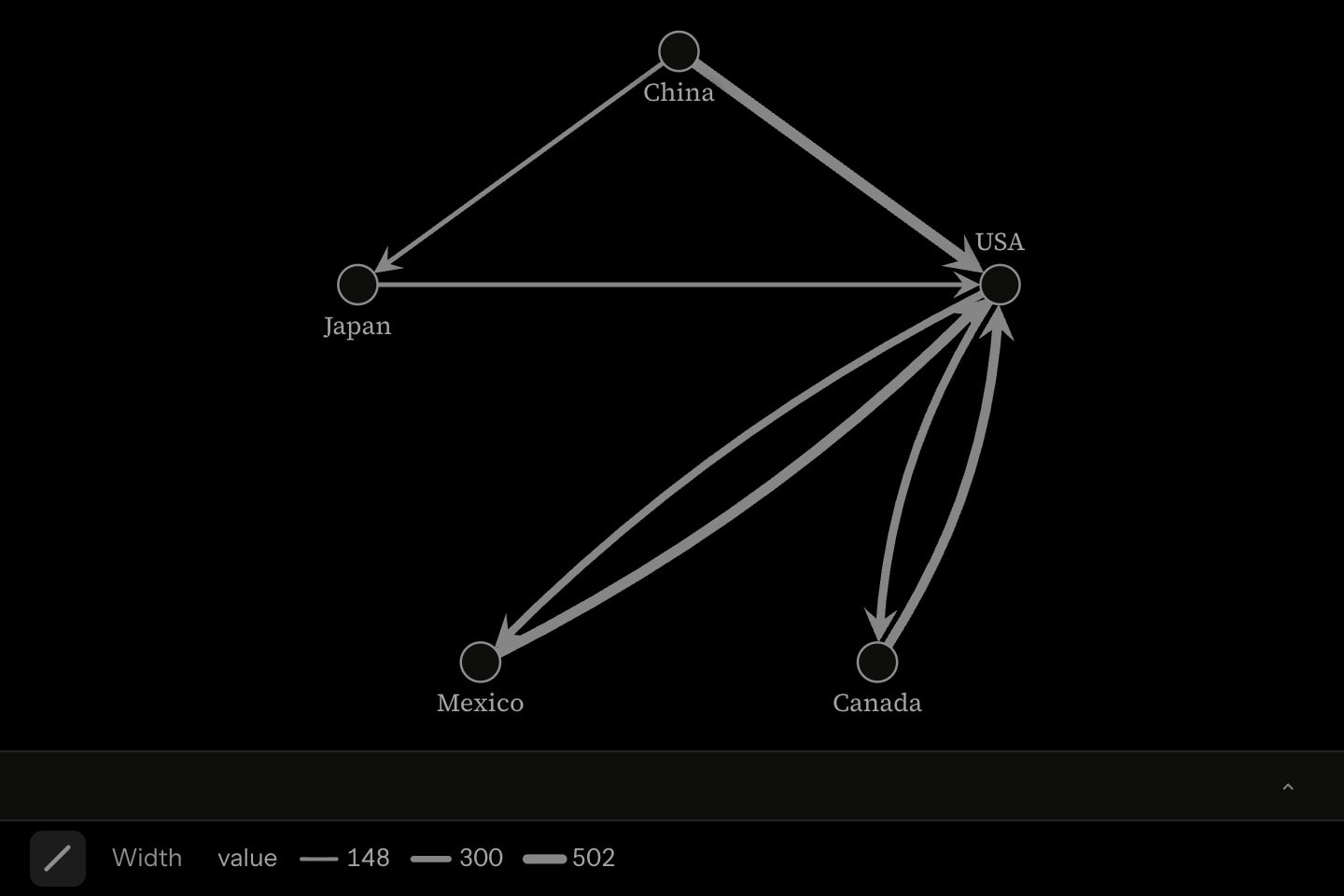
An edge list from , one edge per row: edges(from: #trade.exporter; to: #trade.importer; weights: #trade.value). Every distinct cell in the two endpoint columns is a vertex labelled with its text, matched without regard to case or spacing. An inline vertex or a vertices row whose name matches a cell is that vertex — how a data vertex is named, coloured, sized, or given an #id a path can point at. weights: is the network's own measure of each edge; widths: is the data drawn on it and nothing more; groups: sorts the edges into kinds, each drawn in its own hue under colour-by: group and named in the footer's key. A list with neither from: nor to: lists no rows: its colour-by: and width-by: are the rule for the inline edges — edges(width-by: weight).
edges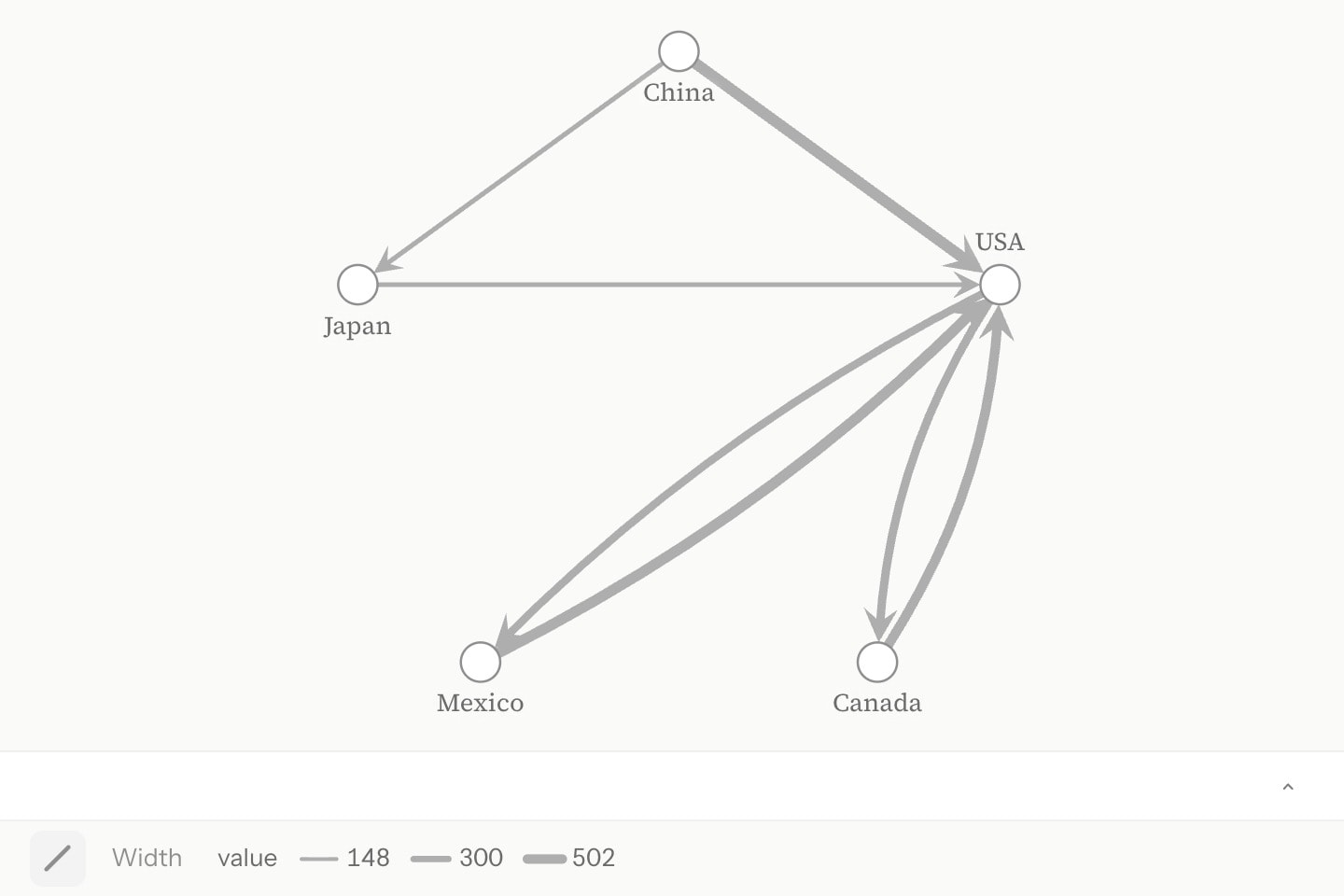
#Attributes
from#data.column. Given with to:, or not at all.edges:valuetoweightssize-by: weight, width-by: weight and show-weights all read it. A cell that is not a number leaves that row unweighted.widthswidth-by: for these edges and changes no measurement — for a quantity that is not the edge's weight, such as lanes on a road weighted by its length.width-byweight draws each edge's stroke in proportion to its weight — the flow map's convention.noneweightnonesliceedges(from: #ties.a; to: #ties.b; slice: #ties.month) with cue.slider:m(over: #ties.month). The rows naming one pair are one edge, so the layout and every measurement take the edges of every slice together, and nothing moves as the slider does. A numeric slice holds until the next arrives — an edge is there or it is not, with no half way between.colour-bygroup deals each of its groups: a hue, named in the key; ends takes the colour of the vertices an edge joins — theirs when they share one, an even mix when they differ; gradient runs from the colour of the vertex it leaves to the colour of the one it reaches; component and community colour the vertices the list brings in by that measurement, and its edges from their ends. none draws every row in the list's colour:.nonegroupendsgradientcomponentcommunitycolor-bynonegroupsmotorway, other road. Each kind is dealt a hue, after any vertex groups so no hue means two things, and named in the footer's key. The data says what an edge is, never what colour to draw it.hueshues: motorway = red, other road = grey — each kind as the data spells it, =, then its colour. The rest are dealt from the palette, skipping every pinned hue.network-hueshue-labelshue-labels: other = Other road — each kind as the data spells it, =, then the name the key gives it.network-hue-labelscolourcolour-by:; unset, a neutral grey.bluelight-bluedark-blueredlight-reddark-redorangelight-orangedark-orangeyellowlight-yellowdark-yellowteallight-tealdark-tealgreenlight-greendark-greenpinklight-pinkdark-pinkpurplelight-purpledark-purplegreylight-greydark-greyneutralhex(…)rgb(…)colordashedfalsehiddenfalse#Allowed in
#Examples
edges(from: #trade.exporter; to: #trade.importer; weights: #trade.value)edges(from: #roads.from; to: #roads.to; weights: #roads.km; widths: #roads.lanes; groups: #roads.kind; colour-by: group; hues: motorway = red, other road = grey)edges(from: #retweets.from; to: #retweets.to; colour-by: ends)cue{
edges(from: #citations.paper; to: #citations.cites)
}(
in: 1
)